




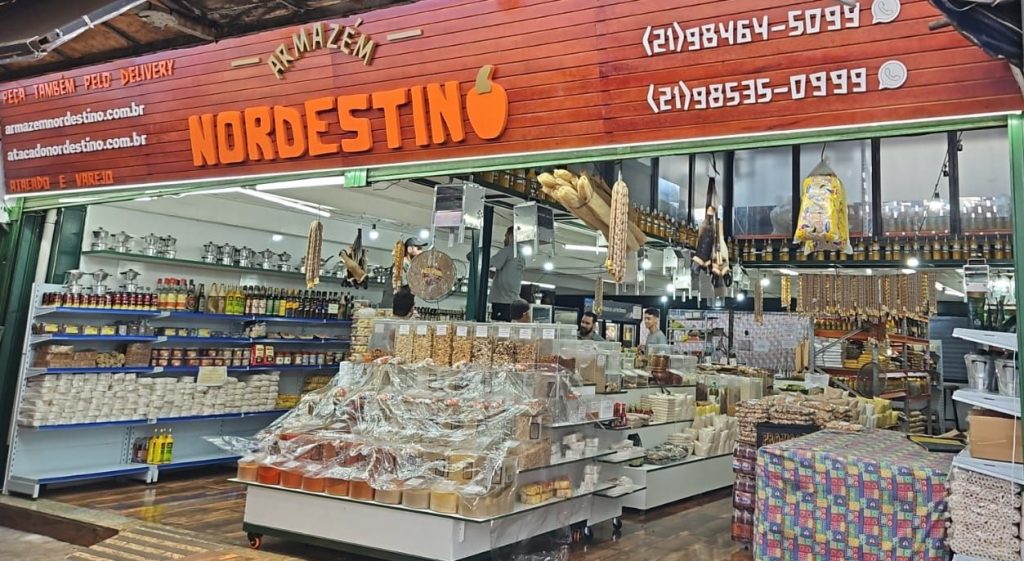
São Paulo – Armazém Nordestino, a retailer specializing in nuts, beverages, cheeses, biscuits, meats, sweets and traditional flours from the Brazilian state of Paraíba, is seeking commercial partnerships to bring its products to Brazilians living in Arab countries. The company focuses on serving consumers who enjoy Paraíba’s regional products, whether in Rio de Janeiro—where it operates a store at the city’s traditional São Cristóvão Fair—or elsewhere in Brazil and abroad.
“We’re very interested in selling our products to Brazilians living there,” said Armazém Nordestino partner Cátia Camaz, referring to the Arab countries.
The company has already made one attempt to export to Saudi Arabia, but the shipment ultimately did not go ahead because each country has its own import requirements. It has, however, successfully shipped products to North Africa’s Morocco. The company’s goal is now to expand its presence in Arab markets as part of its export business.
“We began selling outside Brazil three years ago almost by chance. I was at the post office shipping products to other Brazilian states when I mentioned that I wanted to send our products to Brazilians living abroad but didn’t know how. One of the employees told me I could do it through the postal service. Since then, we’ve sold this way to Portugal, Morocco, France, Italy and the United States. We made just one sale to Morocco about two years ago, consisting of biscuits,” she said.
Camaz said overseas sales of the company’s food and beverages often begin the same way.
“Interest in having Armazém products shipped abroad—sometimes as gifts—usually starts when Brazilians visiting on vacation stop by our store. They enjoy the products and ask whether we can deliver them to the country where they live,” she said.
As the company does not export directly, once an international order is placed, Camaz or her husband, who is also a partner in the business, contacts Brazil’s postal service to arrange the shipment. The postal service then checks with customs authorities in the destination country to determine whether the product can be imported. If the shipment is approved, the order is dispatched. If not, the owners are notified and the purchase is canceled.
How Armazém Nordestino Began
The business, which did not always have a physical storefront, was founded in 2016 by Paraíba native Luiz Fonseca and his wife, Rio de Janeiro native Cátia Camaz.
“My husband moved to Rio when he was 18 and didn’t want to work as an employee. Two years after arriving, he decided to start his own business. Drawing on the traditional foods from his hometown, he chose to work with products he knew well and began selling them door to door. While he was out making sales, I handled the administrative side of the business,” Camaz recalled.
Sales gradually increased, and the business grew along with them.
“We started by selling 10 kilograms of nuts, then increased that to 20 kilograms and gradually added other products, such as honey and clarified butter, to meet our customers’ needs, always sourcing from small producers in Paraíba,” Camaz said.
“In 2019, we opened a physical store in São Cristóvão. During the pandemic, the business expanded again, and in the second half of 2020 we moved to the location we occupy today,” said the systems analyst.
Three years later, as sales continued to grow, the company’s products began reaching customers beyond Rio de Janeiro, primarily in the states of São Paulo, Minas Gerais, Rio Grande do Sul and Paraná, before eventually expanding to international markets.
With a product range of around 450 items, the company’s best sellers include cashew nuts in all their varieties, queijo coalho (Brazilian curd cheese), cassava starch, clarified butter, cowpea beans and farinha d’água, a traditional cassava flour. Products are sold through the company’s website, WhatsApp, Mercado Livre and Shopee. In addition to Camaz and Fonseca, the business employs six staff members to meet demand.
Read also:
Habibah turns bathing into a self-care ritual
Report by Rebecca Vettore, in collaboration with ANBA
Translated by Guilherme Miranda
