



São Paulo – This Wednesday (24th) in Santiago, Chile, the United Nations Economic Commission for Latin America and the Caribbean (Eclac) released its economic growth forecast for this year: 3%. The estimate has been revised down from the last projection, released in April, which was 3.5%.
According to an Eclac press release, the downward revision is partly due to low growth rates in Brazil and Mexico, the region’s two leading economies. Besides, according to the organization, countries which had been growing at high rates have slowed down in the past few months, including Chile, Panama and Peru.
The Economic Overview of Latin America and the Caribbean 2013 points out the weak spots of countries in the region when it comes to facing the adverse foreign scenario, such as dependence on exports to Europe and China; rising current account deficits – which soared to an all-time high in Brazil in the first half this year; fiscal restrictions in the Caribbean, Central America, and Mexico; and South America’s vulnerability stemming from its reliance on natural resources. Regarding current account transactions, the Eclac warns that the deficit may amount to 2% of the region’s Gross Domestic Product (GDP), the highest rate since 2001.
The organization adds that economic growth remains largely dependent on domestic consumption, which is decelerating this year compared with 2012, while the contribution of investment to the GDP should be modest, and the trade balance may show a deficit, as imports are growing at a stronger pace than exports.
The region’s scenario mirrors that of Brazil. Demand-based GDP growth is showing signs of depletion, and the investment volume is not large enough to boost GDP on the supply side. Brazil’s exports are growing at a lower rate than imports, and the country’s trade balance ran a deficit in the first half this year.
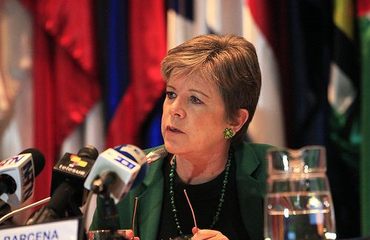
“The current situation highlights problems of growth sustainability in most of the region’s economies, hence the need to broaden and diversify sources of growth. We also need a social covenant to increase investment and productivity, as well as changing production patterns to grow with equality,” said Eclac secretary general Alicia Bárcena, according to a press release from the organization. “We need a social pact to increase investment and productivity, and to change the patterns of production so there is equitable growth,” she added.
The Eclac estimates that Paraguay will lead growth in the region at 12.5% in 2013, followed by Panama (7.5%), Peru (5.9%), Bolivia (5.5%), Nicaragua (5%) and Chile (4.6%). The forecasts for Argentina, Brazil and Mexico are respectively 3.5%, 2.5% and 2.8%. The projections are based on a global GDP growth estimate of 2.3%.
*Translated by Gabriel Pomerancblum

