



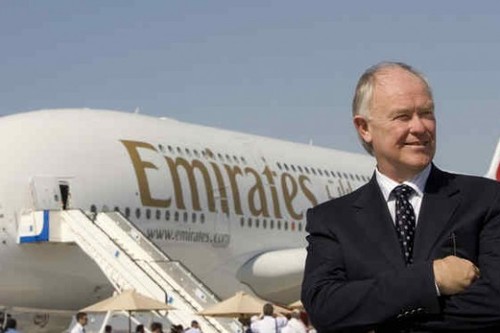
São Paulo – Emirates Airline hopes to transport 70 million passengers by 2020 and is already preparing its infrastructure to support this growth. The information was disclosed by Tim Clark, the company president, and published on the Arabian Business site, from Dubai.
“By 2020, we will have more than 250 aircraft serving some 70 million passengers across six continents. It will make us the largest airline on the planet by international passenger traffic,”, said the executive, on Wednesday (23), during a talk to a delegation of the Bureau International des Expositions, which was visiting the United Arab Emirates to evaluate the possibility of the city hosting the World Expo 2020.
“However, being the biggest airline in the world is not really the end goal. Our aim has always been to connect travellers from around the world to Dubai, and other destinations with just a single stop via our hub. The strategic location of Dubai makes it possible for us to serve almost 90% of the world’s population with non-stop flights,” said Clark.
“The leaders of Dubai recognised this from the onset, and that is why Emirates is investing in the most advanced long-haul aircraft, and why Dubai has invested over the years to develop its infrastructure for international commerce and tourism,” he added.
Currently, Emirates operates some 3,200 flights a week, to 135 destinations in 76 countries. During the 2012/2013 fiscal year, which ended in March, the company transported 39.4 million passengers.
The airline from Dubai is currently the world’s largest operator of Airbus A380 and Boeing 777 aircraft, having placed orders for 53 and 64 aircraft of each model, respectively. “We plan for the long-term and these plans include working closely with our stakeholders in Dubai, including Dubai Airports (the emirate’s airport administrator) and the [General Civil Aviation Agency] GCAA, amongst others, to make sure the right infrastructure is in place to support our planned fleet and traffic growth,” explained Clark.
“We collaborate on every aspect of operations, from technical things like air space and stand operations, to the customer experience such as terminal facilities and efficient processing at check-in. It is a partnership, guided by a clear and steady leadership that recognises aviation as a key economic driver, espouses open competition, and fosters a consensus-based approach to investment,” he finished off.
*Translated by Mark Ament

