



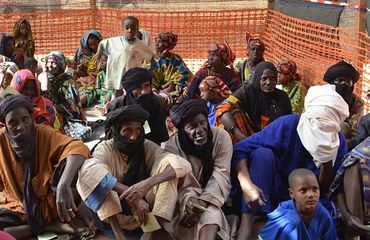
São Paulo – Conflicts in different parts of the planet, like Syria, Palestine, Afghanistan, Mali, Iraq and other countries force millions of people to abandon their houses and settle in camps in neighbouring countries. To portray life in these places, where hundreds of families are sheltered, the NGO Doctors Without Borders (DWB) has set up the exhibition Refugee Camp in the Heart of the City (Campo de Refugiados no Coração da Cidade), which opened this Friday (6th) and will continue until the 15th in São Paulo.
The show is a reproduction of a refugee camp, with tents, pictures, and even dolls emulating life in these settlements. In guided tours, visitors will be able to see the workings of medical practices, vaccination posts, nutrition centres and mental health service rooms.
“The children are the ones who suffer the most. Many arrive at the camps severely malnourished and plagued by other preventable diseases like diarrhoea. They also develop these conditions while staying at the camps, which often operate in precarious conditions with scarce humanitarian aid, which also facilitates the spread of contagious diseases,” says the CEO of DWB-Brazil, Susana de Deus, according to a press statement from the NGO.
The care offered by Doctors Without Borders, according to the statement, varies based on each camp’s needs, are usually include treatment against malnourishment, basic healthcare, vaccination and mental health care. Currently, the Arab countries are demanding the most assistance from the NGO.
“At this time, some of our biggest projects with refugees are in Iraq and Jordan, where the massive influx of people fleeing Syria has led to a grave scenario of humanitarian needs, and the aid available falls far short of the population’s needs,” de Deus explains. “There is also a major, little publicized refugee crisis in South Sudan, where thousands of Sudanese who have fled the conflict in their country are seeking shelter,” says the director according to the release.
According to the organization, refugee camps in Iraq and Jordan alone currently harbour over 672,000 Syrians who left their country to escape the civil war, which is into its third year now. A total of nearly 2 million Syrians have left their country due to the conflicts.
Interaction
At the exhibition, visitors are invited to take on the role of refugees. “Each visitor will receive a card with a short bio of a refugee, and along the way they will be invited to interact as though they were that person,” de Deus explains. “People will be able to talk to our professionals, ask questions, and clarify doubts,” says the director.
According to figures from the United Nations High Commissioner for Refugees (Unhcr), over 45.2 million people are living away from their homes as refugees, asylum seekers (awaiting their refugee documentation) and internally displaced persons (who have left their homes but not their home countries).
In 2012 alone, Doctors Without Borders has provided medical-humanitarian aid to refugees and internally displaced persons in more than 30 countries. The NGO counts on the work of 34,000 physicians.
After São Paulo, the exhibit will feature in other Brazilian capitals.
Service
Refugee Camp in the Heart of the City
September 6th to 15th
Visiting hours: 10 am to 5 pm
Place: Parque do Ibirapuera (Events Arena, access through gates 3 or 10)
Admittance is free
For further information go to www.msf.org.br/campoderefugiados
*Translated by Gabriel Pomerancblum

