



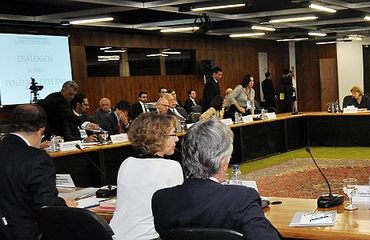
São Paulo – The president of the Arab Brazilian Chamber of Commerce, Marcelo Sallum, was one of the speakers at the event Conversations on Foreign Policy, last Wednesday (19th), in Brasília. The debate series held by the Ministry of External Relations focused on the Middle East and Africa. Sallum gave an overview of relations between Arab countries and Brazil. He noted that according to the Brazilian Institute of Geography and Statistics (IBGE), 0.9% of Brazil’s population claims their families have Middle Eastern roots.
The Arab Brazilian Chamber president said, for instance, that exports from Brazil to the Arab world increased by 407% over the past ten years, from US$ 2.76 billion in 2003 to US$ 14 billion in 2013. On the other hand, Brazilian imports of Arab products went from US$ 2.72 billion to US$ 11.39 billion during the same timespan.
Sallum said, however, that economic exchange between Brazilians and Arabs extends beyond trade and involves mutual investment, including the port terminal operated by Dubai’s DP World in Santos, Brazil, and the food plant owned by Brasil Foods in Abu Dhabi, among others.
He stressed that since 2007, five direct flights from Arab countries to Brazil were inaugurated; prior to that year, there was none.
As regards diplomacy, Sallum said the signing of agreements for mutual investment protection and to prevent dual income taxation between Brazil and Middle Eastern and North African countries can pave the way for further business opportunities.
The Arab Brazilian Chamber president also said the Mercosur has negotiated free trade agreements with Arab countries, and two of them, with Egypt and Palestine, have already been signed, but did not enter into force because they are pending approval from the parliaments of the South American countries at hand.
The Mercosur has entered into similar talks with the Gulf Cooperation Council (Saudi Arabia, Bahrain, Qatar, the United Arab Emirates, Kuwait and Oman), Morocco, and Jordan, but the discussions have not come to an end yet. Sallum stressed the need for swifter dealings.
He also touched on a few issues that hamper Brazilian business with Arab countries, such as the Saudi ban on Brazilian beef, which should end once an agreement is reached by the two governments; the 250% tax levied on Brazilian beef imports by Morocco, which renders business impossible, whereas Argentine enjoys free access to the Moroccan market; and difficulties experienced by Brazilian enterprises on exporting medical and hospital equipment to Iraq, while United States, Europe and Japan face none.
The Arab Brazilian Chamber president also spoke on the importance of holding official missions and business missions, and suggested that visa issuance to business travellers be made simpler.
*Translated by Gabriel Pomerancblum

