



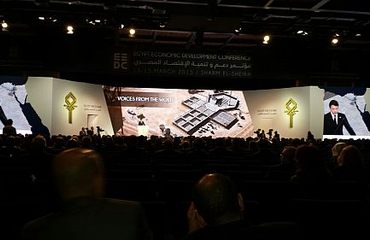
São Paulo – Ambassador Paulo Cordeiro, undersecretary-general of Politics III of the Brazilian Foreign Ministry, aka Itamaraty, had a brief meeting with Egyptian president, Abdel-Fattah El-Sisi at the Egypt Economic Development Conference, which started this Friday (13th) and goes on until Sunday (15th) at beach resort Sharm El-Sheikh, at the Red Sea coastline. He extended to the head of state that Brazil has an interest in promoting bilateral cooperation actions.
“I said to the president that Brazil has areas of excellence that can be used to leverage our relations with Egypt”, said the diplomat to ANBA through the phone. Cordeiro’s post is equivalent to vice-minister and he is responsible for the relations with the Middle East and Africa at the Ministry of External Relations.
The ambassador greeted Sisi at the behalf of the Brazilian government, and the president thanked president Dilma Rousseff for sending representatives to the event. According to Cordeiro, Brazil was the only country in South America to send representatives from its capital to the conference, the other countries sent their Cairo-based ambassadors.
The diplomat reported that the forum welcomed officials from several countries, among them ministers and heads of state and government, proof that there are serious misgivings about the economic, social and political stability of Egypt “as a key factor for regional security.”
“This conference is crucial to the future of Egypt, a vision of how the country should be,” Cordeiro said. “Many are the leaders of Arab and Mediterranean countries, China and the United States who reaffirm Egypt as an essential component within the Arab world,” he added.
According to Egypt’s Al Ahram newspaper website, Gulf countries have announced US$ 12.5 billion worth of aid and investment in Egypt – US$ 4 billion each from Saudi Arabia, the UAE and Kuwait and US$ 500 million from Oman.
According to Cordeiro, the event is designed to pool resources to support Egypt in its struggle against radicals and display hope in building democracy and human rights observance in the country.
Cordeiro gave thanks to the Arab Brazilian Chamber of Commerce for attending the conference, represented by its government relations executive Tamer Mansour. He stressed that the organization acts as an intermediary for major enterprises.
Four years after the Arab Spring, which, in Egypt, capped the near-thirty year rule of former president Hosni Mubarak, the country is trying to signal with the conference that it’s back on track to political stability and economic development. The government intends to arouse interest from local and foreign investors alike by hosting the event, whose subtitle is Egypt: the future. Weak economic performance, unemployment and inflation are the underlying causes of the population’s discontentment.
However, the country’s democratization is overshadowed with doubt. Sisi was elected after leading the ousting of former president Mohamed Morsi, the Muslim Brotherhood affiliate elected in the wake of Mubarak’s overthrow, and his administration is coming down hard on the political-religious organization and other opponents.
*Translated by Sérgio Kakitani & Gabriel Pomerancblum

