




São Paulo – Staging a play in a country where another language is spoken may sound somewhat complicated—unless it’s a mime troupe. For the theater company Sabre de Luz Teatro, however, it was a challenge that was overcome and met with great enthusiasm. In November 2025, the group took part in two festivals in Morocco: the International Youth Festival in Taza and the International Children’s Festival in Fez. To perform Five Weeks in a Balloon, inspired by the work of Jules Verne, the actors even learned to speak French (the country’s official language is Arabic, but French is widely used and taught in schools).

“Yes, we performed in French without speaking the language! We adapted the text and studied specifically for the festival for a month,” says Joyce Salomão, an actress, director, and playwright who adapted Verne’s text for the production. “It was a very challenging process because it required a new level of precision in performance, especially in comedic timing; the body and speech, shaped by the language’s rhythm and sound, as well as imagery and visual construction, became even more important.”
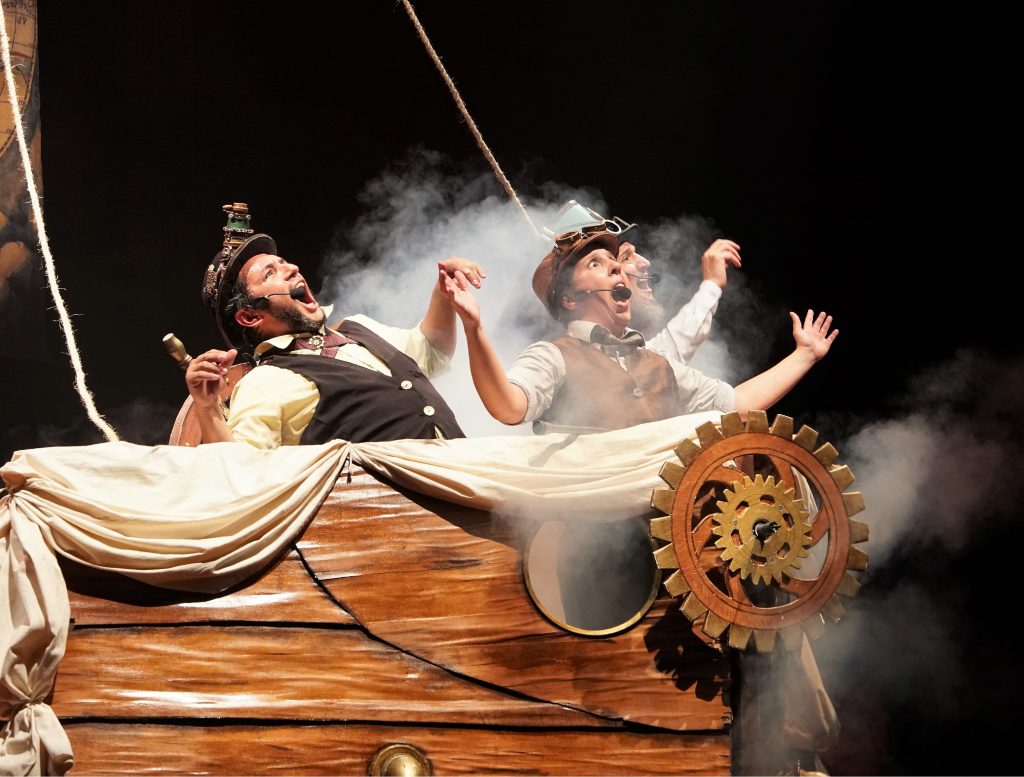
The process reinforced something that was already central to the troupe’s work: physical and visual dramaturgy (with the use of technology). Whenever the characters overcame obstacles—such as the balloon crashing in the desert or the fight with the giant mechanical shark—they would say in French: “Suuuper!” At the end of the performance, during the audience interaction, children would playfully repeat: “suuuuper!” “Our goal is achieved when we enchant the audience and make them feel part of the journey!” says Joyce.
It was not the first time Sabre de Luz Teatro had been to the country. In 2019, the company took part in the Children’s Theater Spring festival in Nador. The invitation came through a referral. Joyce believes this initial contact led them to the curators of the Taza festival. The festival in Fez, in turn, came through a recommendation from a French artist they also met in Nador.
Last year, the tour also included Portugal and Spain. “It was an extremely enriching experience—this is the main reason for our interest in internationalization: to broaden our artistic, philosophical, and social perspectives. The most interesting aspect was realizing how theater can break barriers despite cultural and linguistic differences and create direct connections with the audience,” the actress and director summarizes.
Twelve years of the balloon
The play premiered in 2014 and has had more than 400 performances since then, including international ones. “And we want to take even more flights! Our dream is to travel the world with this balloon,” says Joyce, who founded the company in 2013 with the aim of combining theater and technology—as a language rather than as a mere effect, she emphasizes.
…we continue to sustain our work because we believe in the transformative power of our theater…
Joyce Salomão
From the outset, the proposal was to develop a unique language that merges theater and science fiction, something still little explored in Brazil. The company develops its work mainly through public grants, incentive laws, touring productions, and institutional partnerships. Over 13 years, they have made several projects possible, building a repertoire of seven productions and establishing their own creative structure, including a workshop. The endeavor has earned more than ten awards.
“It is a journey of great persistence. Working with artistic research in Brazil still involves significant structural challenges, especially due to limited resources and the discontinuity of public policies. Even so, we continue to sustain our work because we believe in the transformative power of our theater and in the urgency of building, in the present, futures that do not yet exist,” she says.
Stages of life
Joyce began her artistic life as a dancer—her first dance festival was at the age of three. “I have a very vivid memory of that day: in the middle of the choreography, I stopped and wet my tights. My teacher picked me up, rushed me to the dressing room, changed them, and put me back on stage in the middle of the routine. And I continued as if nothing had happened. I remember how happy I felt when I finished the choreography.”
I decided to be a good example rather than a “good mother,” and that included fighting for my dreams.
Joyce Salomão
She spent 16 years dedicated to dance, participating in more than 20 festivals. At age 12, she began acting and had her first professional production at 17. After that, she stepped away from the stage for family reasons—a difficult period in which she felt out of place, “like a fish out of water, as if life had lost its meaning.”
At 22, when her son was born, she made a definitive decision: “I understood that art was not just a choice, but part of who I am. I decided to be a good example rather than a ‘good mother,’ and that included fighting for my dreams. I made a promise to myself that I would never again stop acting and dancing for the rest of my life. And I have kept that promise.”
Fortunately for audiences, who respond in unison: “Suuuuper!”
Read more:
Granddaughter of Syrians turns memory into art
Report by Débora Rubin, in collaboration with ANBA
Translated by AI
