



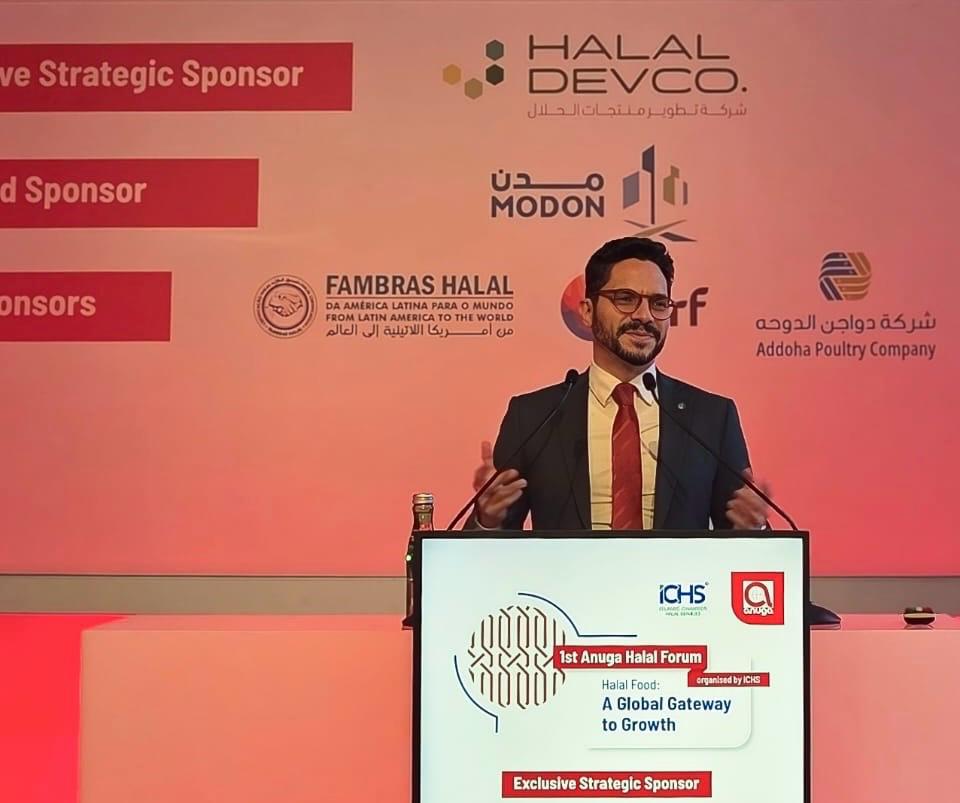
São Paulo – The head of the Arab-Brazilian Chamber of Commerce (ABCC) office in Dubai, United Arab Emirates, Rafael Solimeo, presented on Monday (6) Brazil’s expertise and capacity in producing halal food and beverages at Anuga, one of the industry’s largest trade fairs, held in Cologne, Germany. He took part in the first Anuga Halal Forum, delivering the lecture “Global Export Strategies: Brazil Capitalizing on Opportunities in the Halal Food Market.”
“Brazil is still widely known as a producer and supplier of commodities and food raw materials, but there’s a challenge in creating space and working with entrepreneurs on higher value-added products, in addition to maintaining achievements as a commodity supplier,” he said. Halal products are made in accordance with Islamic standards and fit for Muslim consumption.
In his presentation, Solimeo shared figures showing that Brazil’s exports to Islamic countries are growing year by year, and that the country is the leading supplier of chicken, corn, soy, peanuts, sugar, and frozen orange juice, as well as the second-largest supplier of beef and animal-derived gelatin, and the third-largest exporter of melon and herbal tea.
He highlighted the challenges that Brazilian halal products still face in growing globally and in the Arab world. There is still a lack of awareness worldwide about halal products, which are made according to important Islamic standards that also translate into high quality, hygiene in handling, and production processes.
Transportation, however, is still expensive and time-consuming, as a product shipped today from a Brazilian port can take up to 45 days to arrive at a port in the UAE, for example. This transit time is expected to decrease, as shipping company MSC announced the launch of a direct refrigerated container line between Brazil and the UAE later this month, which will eliminate the need for cargo transshipment at an intermediate port along the route between the two countries.
Halal do Brasil project
In his lecture, the executive also presented the Halal do Brasil project, an initiative spearheaded by the ABCC to promote made-in-Brazil halal products beyond the Arab nations. In September, for example, Brazilian companies took part in a fair in Malaysia through the project, which also participated in Anuga in 2023.
“It is extremely important to be here to show that we [at the ABCC] don’t operate only in the Arab world, but also carry out activities in other Islamic countries, and that we’re one of the few institutions in the sector to have operations outside Brazil. It was very important to be here, positioning Brazil’s halal products in Germany. People from various countries came to speak with me after the lecture, eager to learn more about Brazil as a halal producer,” he said.
Solimeo presented the Brazilian company Ecofoods as a case example. The company manufactures products based on açaí, a fruit harvested in the Amazon rainforest. Ecofoods joined the Halal do Brasil project in 2023, obtained halal certification, and has been exporting to the UAE since. It serves as an example of a company producing higher value-added products with an international presence in the halal market.
In addition to Solimeo, Brazilian halal product certifiers are at Anuga, along with Brazilian companies located in the Latin American country’s pavilion at the fair. The executive will have a series of meetings in Cologne and Berlin in the coming days.
At the fair, he was set to meet with companies from Arab countries such as Lebanon, Palestine, and Saudi Arabia to invite them to participate in two events where the ABCC has booths in Brazil: the Anuga Select Brazil fair and the APAS fair, focused on the food and supermarket sectors. He also presented the Global Halal Brazil Business Forum, which will be held by the ABCC in partnership with certifier FAMBRAS Halal on October 27 and 28 in São Paulo.
Read more:
Halal Project to bring Brazil’s expertise, flavors to Anuga
Brazilian firms eye halal market at MIHAS fair
Translated by Guilherme Miranda
