


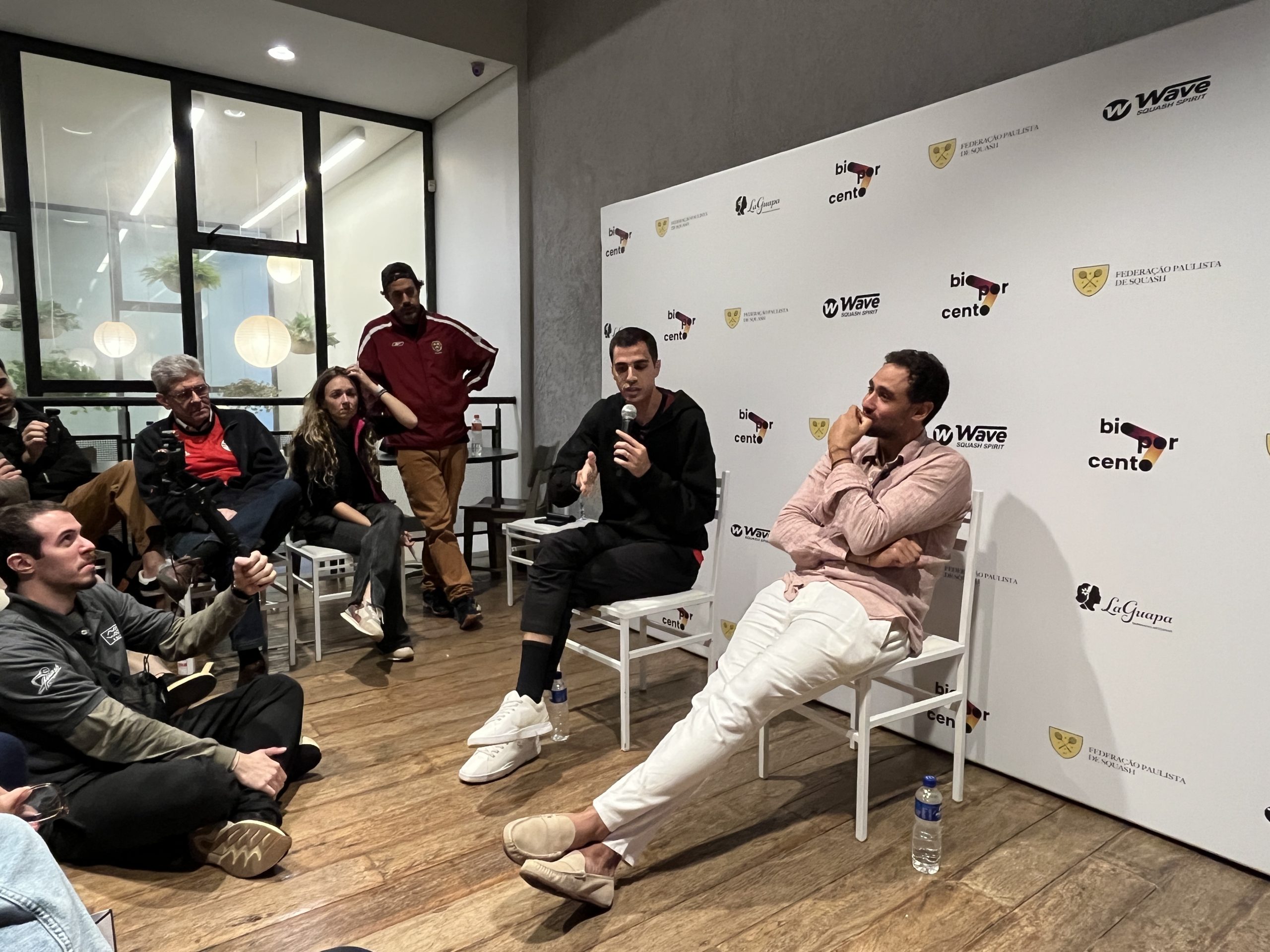
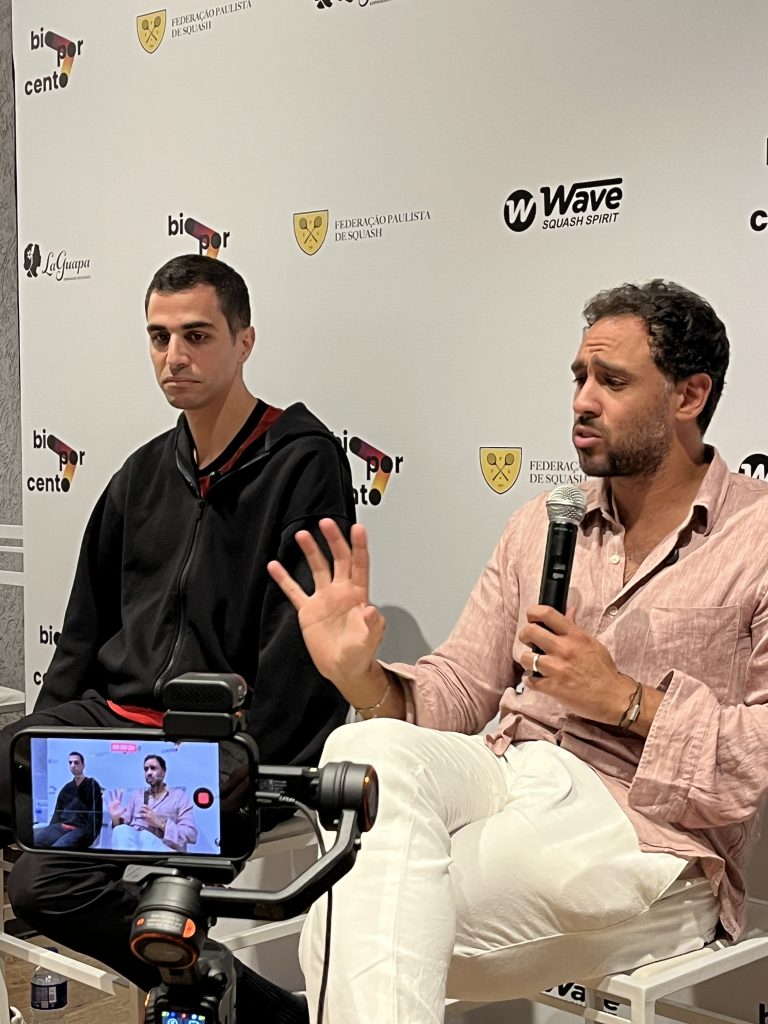
São Paulo – In an intimate setting with around 40 participants, including sponsors, players, and squash enthusiasts, athletes Ali Farag, 34, and Ramy Ashour, 38, spoke about their careers, behind-the-scenes experiences, and the challenges of the sport on the opening day of the 1st Squash Experience.
The event brought together players and squash enthusiasts alongside prominent former Egyptian athletes, helping put Brazil on the global squash map and bringing the sport closer to Brazilian audiences.
Egyptians Farag and Ashour, four-time and three-time individual world squash champions, respectively, were special guests at the event, held on June 15 and 16 and organized by Bio por Cento, a venue located in the western area of São Paulo.
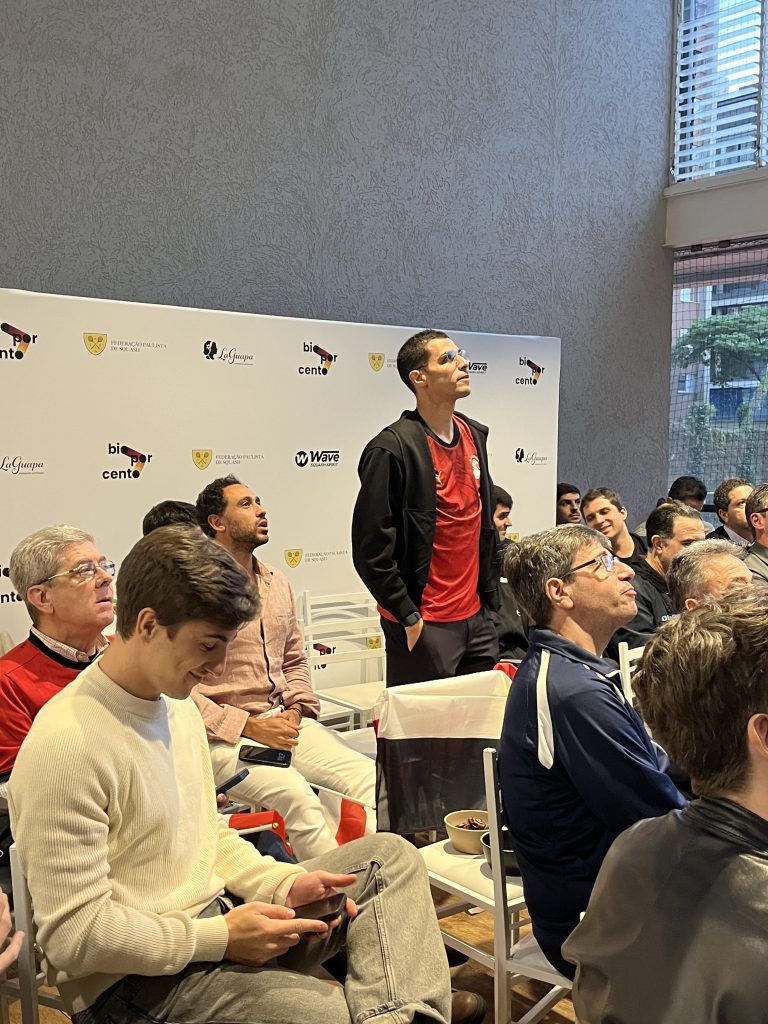
On June 15, in addition to speaking with participants, the former players also watched Egypt’s opening match against Belgium at the FIFA World Cup. Although Egypt was not considered the favorite, the Egyptians were pleased and proud to see their national team hold the European side to a draw.
“We have great things to say about Brazil. The country is beautiful, the food is excellent, and the people are amazing—very kind and incredibly welcoming to us. This event has been unique in many ways, but the best part is that I get to share it with my idol,” said Ali Farag.
“When I was the age of the young players here today, I looked up to Ashour and learned from him. Fortunately, I didn’t have many chances to share the court with him, because he would have humiliated me,” he joked. “But now, seven years after his retirement, I have this opportunity, which is truly unique, and for that I’m grateful.”
Clearly enthusiastic, Ashour spoke about the importance of taking part in the event.
“First of all, I want to say that it is an honor for us to be here. You have done an incredible job creating this wonderful community, and I believe moments like this are among the noblest things one can do for a sport: educating new generations, attracting people, and building communities. I think that is truly remarkable. Thank you for doing this in Brazil—it’s amazing.”
Moments like this are among the noblest things one can do for a sport: educating new generations, attracting people, and building communities
Ramy Ashour
Having been involved in the sport since childhood, both athletes were influenced by their families. While Ashour looked up to his brother as a role model, Farag was inspired by his father.
“I started playing when I was six years old. My father used to play recreationally with his friends, and my older brother and I would sneak into his training sessions. That’s how I fell in love with the sport. I competed in local tournaments in Egypt and in international events when I was younger. During college, I played in professional tournaments, but I wasn’t dedicated to the sport full-time. I returned to full-time competition after graduating, at the age of 22,” Farag recalled.
Squash played a major role in his life, not only as his professional career but also as the path that led the Egyptian athlete to study Mechanical Engineering at Harvard.
“I retired last year, but my life revolved around squash. Because of the sport, I met my wife, who was also a player, got into college, and met incredible people. Like every athlete, I thought about quitting several times, but fortunately I had good people around me who believed in me, encouraged me, and convinced me to keep going.”
Also passionate about the sport, Ashour spoke about his own journey.
“I started playing when I was six years old and was already obsessed with the sport. At 10 or 11, I began dreaming of becoming a professional player, and I received complete support from my parents, especially my mother. Honestly, aside from losing matches, my biggest challenges were my injuries.”
Retired since 2019, Ashour founded his own squash academy, where training sessions are held for squash enthusiasts. With four locations across Egypt, the academy offers professional coaching and an extensive home-training program.
On Tuesday morning, during the second day of the 1st Squash Experience, the Egyptian guests shared tips and discussed playing techniques with members of Bio por Cento. At the end of the event, the two former athletes are set to face each other on the squash court.
Sport in Egypt
Considered a global powerhouse in squash, Egypt has dominated the sport for decades and holds many of the top positions in the world rankings.
“In our country, squash is very important, and we’re very successful at it. Obviously, football is number one, but people are starting to follow squash as well,” Farag said.
According to Farag, Egypt’s success in producing top-level players year after year comes from early specialization.
“In the United States, for example, children play many different sports and only specialize when they get older. In Egypt, they specialize from a very young age. By the time I was 11, I was already training squash for two to three hours every day.”
According to Ashour, the ability to solve problems is what helps the Arab country consistently reach the top of the world rankings.
“We have a great history in the sport, and like Brazilians, we are good at sports. I think that’s because we are very skillful and good at solving problems. On the court, if you are too systematic and keep repeating the same shot over and over, you are not doing anything different. The game has to be very natural, and each shot should be different from the last. There is no consistent pattern, and I think Egyptians are very good at that.”
For Brazil to begin inspiring interest among future generations from an early age, as Egypt has done, Farag offered advised, “In squash, from the very beginning, the most important thing to teach is not technique. Children need to be taught to love the game. Throughout any athlete’s career, there are moments when we absolutely hate squash. Ashour didn’t enjoy dealing with injuries and defeats. I didn’t enjoy leaving my family behind to compete in tournaments. But what kept us going was our passion for the game.”
Read also:
Arab highlights at the World Cup
Report by Rebecca Vettore, in collaboration with ANBA
Translated by Guilherme Miranda
