


São Paulo – Airplane, a short film written and directed by Egyptian filmmaker Mohamed Beriky, is among the finalists of the AI for Good Film Festival, organized by the United Nations agency specializing in digital technologies (ITU). Produced by Beriky with the support of artificial intelligence, Avião portrays the world through the eyes of an autistic child living in São Paulo, the city Beriky chose as his home in Brazil.
Speaking to ANBA, the filmmaker said the idea for Avião first came to him while he was still working in social services, his professional field before entering filmmaking. “During my training, autism was one of the subjects that left the strongest impression on me. Even then, I had written it down as a possible film project. But I never wanted to make an educational film or a kind of medical diagnosis of autism. The goal was never to ‘explain’ autism, but to try to understand that world—to see a child on the autism spectrum from the child’s perspective, rather than only through the eyes of adults,” he said.
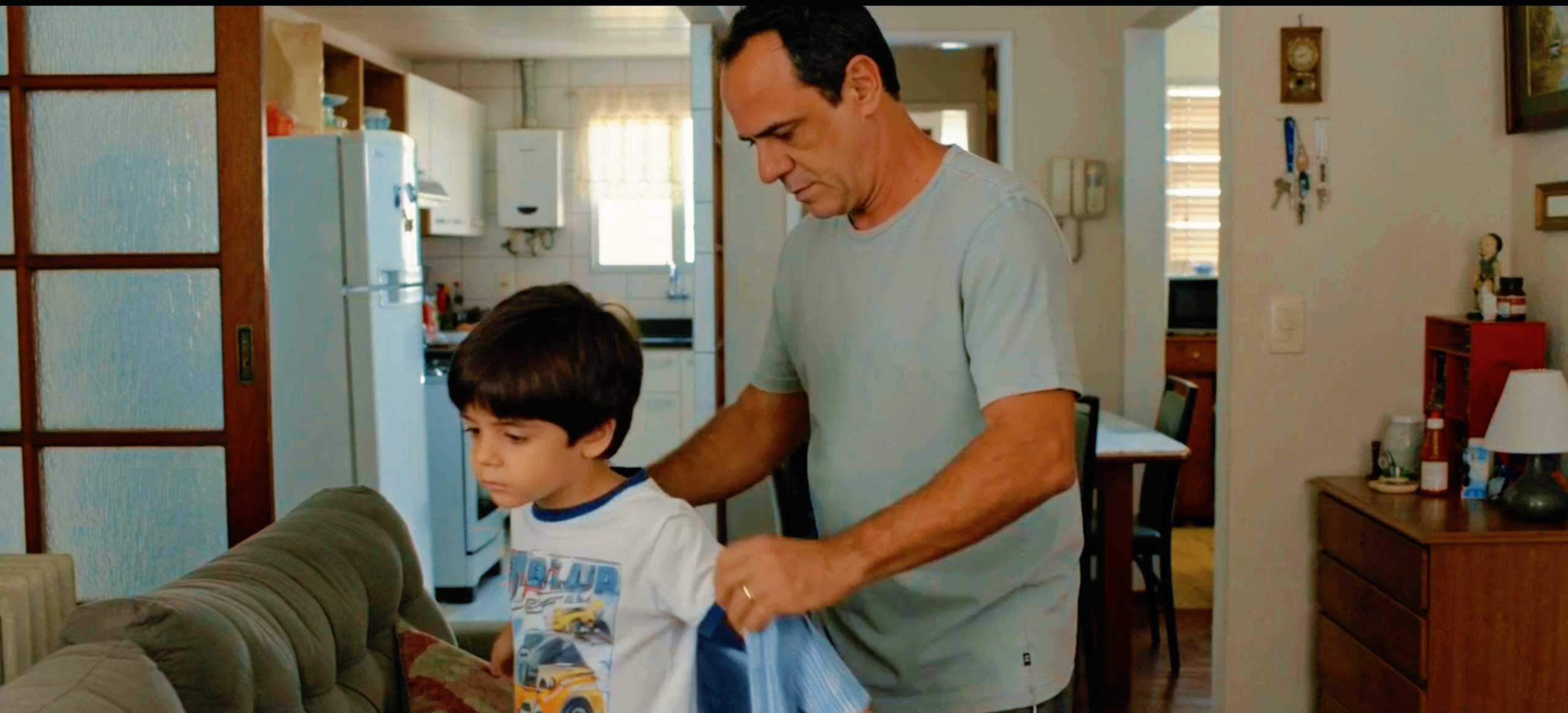
In Avião, an autistic boy notices an airplane painted on a wall along a busy São Paulo street while his father, running late for work, grows increasingly stressed in traffic. The boy begins repeating the word “airplane,” but his father ignores the cue until, overwhelmed by the emotional weight of the moment, he envisions a plane crashing—a manifestation of the profound shift taking place in his own perception.
“In Avião, AI was especially important because the film needed to blend realism with subjective perception. There is an ordinary morning, a father running late, a child, and São Paulo traffic. But there is also an almost sensory inner shift, when the father finally realizes that the repeated word carried a meaning he had failed to grasp,” Beriky explained.
The film was officially released on April 6, following two weeks of research, development, and scriptwriting. Another week was then devoted to the film’s visual production, using two AI-powered content generation programs. The screenplay and overall artistic vision were entirely conceived by Beriky. AI was used to create the film’s realistic visuals—its characters, settings, and everything seen on screen was generated from Beriky’s prompts.
“One of the biggest challenges was finding the right tone. AVIÃO could not feel like an educational video about autism, nor could it use AI merely as a visual spectacle. The challenge was to make the audience experience the confusion, the pressure, the repetition, and, ultimately, the delayed understanding,” the filmmaker said.
“Another challenge was maintaining emotional and cinematic coherence within an AI workflow. AI can generate powerful images, but cinema is not just about images. Cinema is rhythm, choice, silence, point of view, editing, and responsibility for what you are trying to say,” he added.
Being selected as one of the finalists for the AI for Good Film Festival is another milestone in the film’s journey, as Avião has already been a finalist or winner at several other competitions. “For me, this journey is very meaningful because it shows that the film is not being seen merely as an AI experiment. It is being recognized as cinema, as a human story, and as an attempt to use technology to foster empathy,” Beriky said.
Before embracing digital filmmaking, the director worked with motion picture film and photographic negatives. He produced television programs in Saudi Arabia, took part in productions in Turkey, and also worked in advertising. He has lived in São Paulo for six years, is married to a Brazilian, and has two Brazilian children. “In a way, Brazil has ceased to be just a place where I live—it has become part of my life, my family, and my artistic identity,” he said.
On July 9, all eyes will be on Switzerland for Beriky, as Avião is set to be screened at the festival in Geneva. From that date onward, the film will also be available to watch online.
Read more:
Brazilian launches autobiographical book in Gulf
Translated by Guilherme Miranda
