


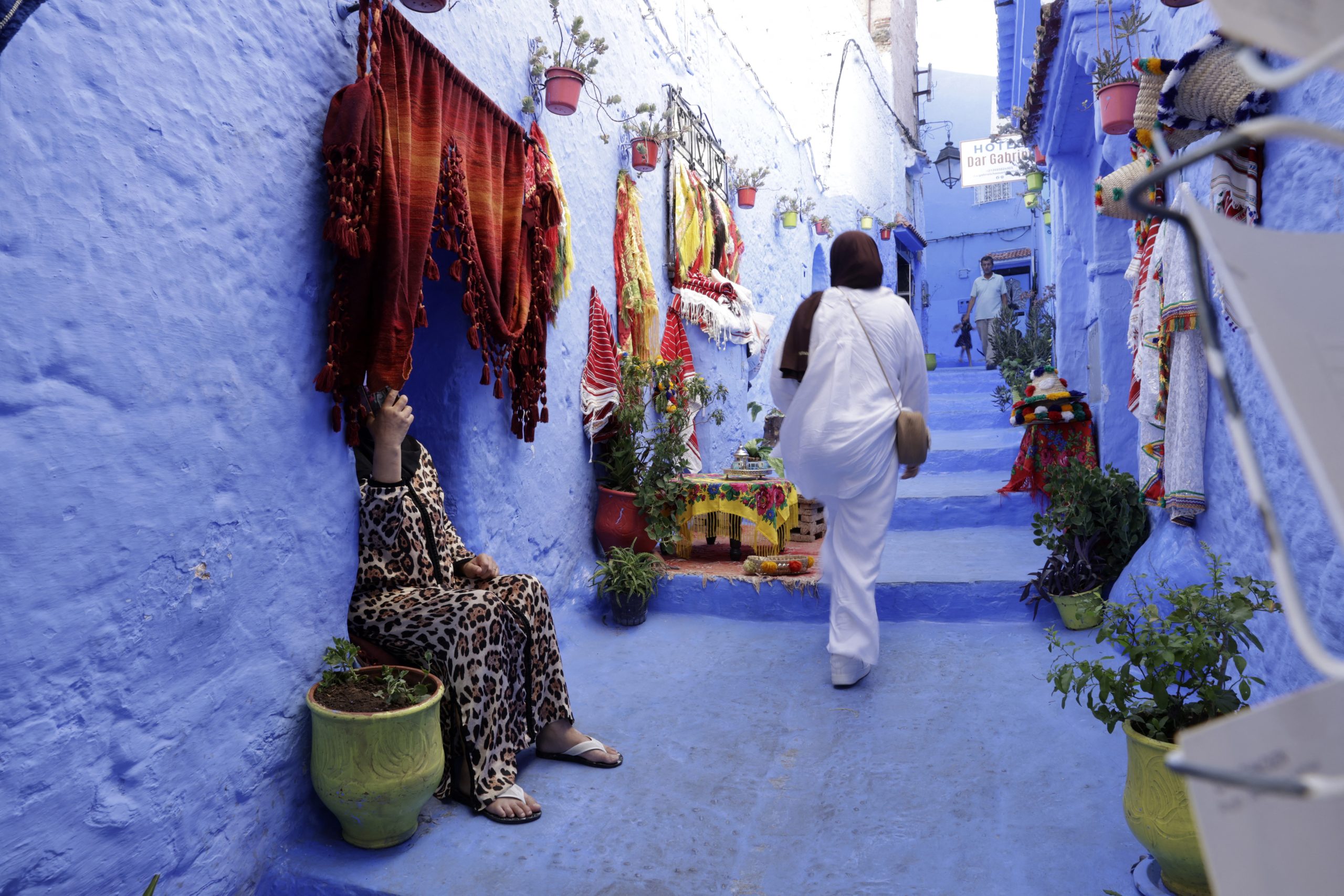
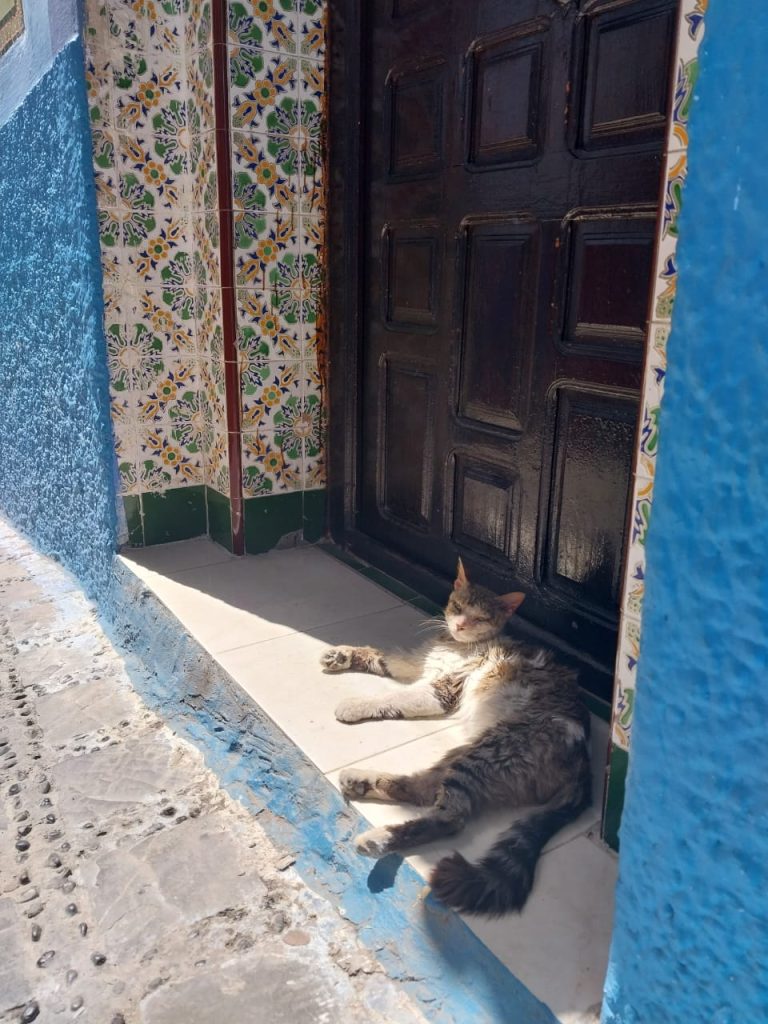
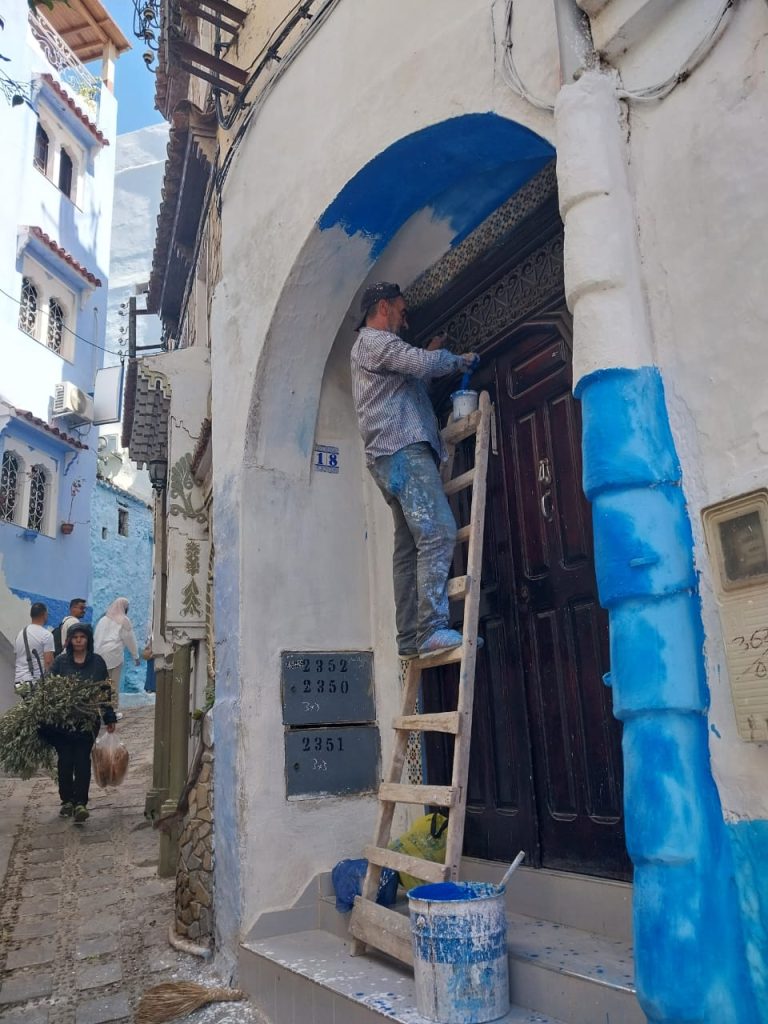
Chefchaouen – A tabby cat stretches on the outdoor steps of a blue house. Passersby try to get its attention, but the animal is basking in the sun and seems completely unbothered. A few meters ahead, a man standing atop a ladder is repainting the wall of his home—also blue—while chatting with people walking by. He is happy to be photographed at work, unlike the woman in a colorful hijab on the next street, who offers freshly baked bread from another blue building but prefers not to have her picture taken.
Around the cat, the woman, and the man, everything is blue because their lives unfold in Chefchaouen. Visitors from around the world come to see the old city, or medina, drawn by the blue that dominates its buildings, but they also encounter something equally valuable: everyday life itself.
Unlike some tourist destinations designed solely for travelers, Chefchaouen’s blue walls belong to shops and homes inhabited by people who trade, live, work, celebrate, fall in love, feel moved, arrive and depart, miss loved ones, cry, and laugh.
It is easy to understand why, in one corner of the medina, someone painted a polite public request in elegant letters asking people to keep their voices down. Someone is trying to sleep—or soothe a baby to sleep.
Tour guide Aladin Boukhajjou explains that the city does not start its day particularly early, with most activities getting underway around 10 a.m. As part of that vibrant daily scene, Boukhajjou greets acquaintances—sometimes warmly, sometimes more formally—as he walks through the medina, introducing it to visitors.
Blue houses can be found throughout Chefchaouen, but the color predominates within the city’s historic walled quarter. In the medina, a central square called Uta El-Hammam brings together a mosque, a fortress, cafés, restaurants, and several hotels, serving as the hub from which visitors access the narrow streets lined with shops and homes painted in varying shades of blue.
A stroll through the medina’s narrow alleys is a unique experience. A resident may invite visitors to peek inside their home, and shopkeepers will certainly encourage passersby to step inside, offering ceramics, shoes, bags, clothing, souvenirs, spices, scarves, tableware, and countless other items—most of them handcrafted by local artisans. Chefchaouen’s medina is a paradise for those who love shopping.
At one corner, spotting a group of Brazilians, the owner of a shop selling football-themed textiles smiles and recalls that Morocco and Brazil will face each other in the FIFA World Cup on June 13.
In another store, while searching the stockroom for a pair of leather sandals in the requested size, the shopkeeper remarks that he enjoys being there, at the back of the long shop. “It’s quiet here,” he confides to the customer.
Through a tiny doorway, another Moroccan painstakingly crafts refrigerator magnets and beautiful paintings by hand, all while warmly attending to customers—a blend of artisan and shopkeeper in one.
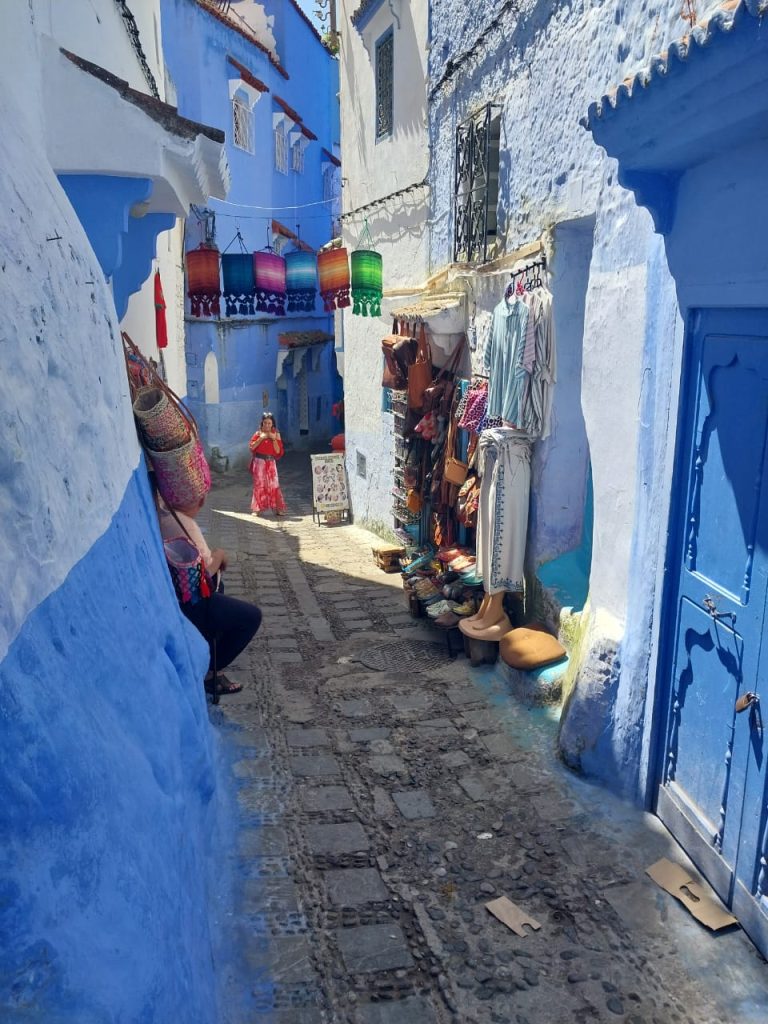
There are several theories about how blue arrived in and became established throughout Chefchaouen. But guide Boukhajjou says tourism led residents to paint virtually everything in the color.
Tourism, however, did not drive locals away. On the contrary, local residents and Europeans live side by side among the shops.
“Many Europeans, especially Spaniards, have decided to move here. Some rent houses and turn them into hotels. But there are also many retirees, because it’s cheaper than Europe, and at the same time, very close to Ceuta,” says the Moroccan guide, referring to the Spanish autonomous city located on the African coast.
Surrounded by the Rif Mountains, which add to the charm of its landscape, Chefchaouen was founded in the 15th century as a stronghold against Portuguese incursions. The different nationalities, ethnic groups, and religions that shaped life in the medina over the centuries left their marks, some of which can still be explored at the historic sites around the central square, including the Kasbah, or fortress.
According to the guide, tourism first emerged in the city in the early 20th century, when Spain took control of northern Morocco, and it has continued to thrive ever since.
Chefchaouen is in northern Morocco, about 100 kilometers from Tangier, 240 kilometers from Rabat, 340 kilometers from Casablanca, and nearly 600 kilometers from Marrakesh. Royal Air Maroc operates direct flights between Casablanca and São Paulo and, in the second half of next year, will also launch a direct route to Rio de Janeiro.
Read the other stories in ANBA’s series on tourism in Morocco:
The journalist traveled at the invitation of Royal Air Maroc, Dar Ba Sidi & Spa, and Alizés agency
Translated by Guilherme Miranda
